





Dramatic Marketing Episode 4: How Alan Cumming Sold Tickets to His Own Show (By Actually Selling Tickets)
There’s a rule I come back to every single time I’m trying to figure out how to market a show.
The marketing message has to match the artistic message.
I talked about this in the Godspell crowdfunding post. And I’m going to keep saying it until the whole industry has it tattooed somewhere visible. Because it’s that important.
When you nail that match – when the how you sell it is an extension of the what it is – that’s when marketing stops feeling like marketing.
That’s when it becomes part of the show.
https://youtu.be/OMlx2qakoM4The Show That Demanded Something Different
Macbeth (yes, I can say it because we’re not in a theater right now) was unlike anything Broadway had seen at the time.
John Tiffany directed. Alan Cumming starred.
And Alan didn’t just play Macbeth.
He played everyone.
Macbeth. Lady Macbeth. Malcolm. All of it. One man. Every role.
So when we sat down to figure out the marketing campaign, I asked myself the same question I always ask: What is unique about this show?
The answer was obvious.
One man does it all.
The Idea
Once you’ve identified what makes a show singular, the next step is finding a way to demonstrate that singularity – not just describe it.
Anyone can put “one man performs all the roles” in a press release.
That’s boring. That’s forgettable.
I wanted people to experience Alan’s range before they ever bought a ticket.
So I thought . . . what if Alan played one more role?
What if he played the box office treasurer?
We put him behind the box office glass. We kept the shades down. And we surprised the rush line (real theatregoers, standing there hoping to score last-minute seats to see Alan in the play) by having Alan himself slide open the window and sell them their tickets.
That’s it.
Simple.
Perfect.
Why It Worked
Here’s the thing about Alan Cumming that makes him a producer’s dream, besides the fact that his talent is, frankly, ridiculous: he is up for anything.
Pitch him something. If he likes it, he doesn’t just say yes. He says, “Let’s go. Right now.”
That energy – that fearlessness – is exactly what you see in the play. He’s out there every night giving everything he has, playing every single character, carrying the entire emotional weight of one of Shakespeare’s most demanding works.
And standing behind that box office glass, the rush audience saw it in real time. They saw how hard he works. They saw how game he is. They fell even more in love with him . . . which, if you’ve ever seen Alan Cumming onstage, you know is saying something.
The video spread. It got views. It got attention.
But more importantly . . . it meant something.
Because we weren’t just pulling a stunt. We were telling the truth about the show in a new way. You’re going to see one man do it all. We weren’t just saying it.
We were proving it.
The Rule, Restated
I’ve said it before and I’ll keep saying it: the best Broadway marketing doesn’t feel like an ad.
It feels like a preview.
When Alan sold those rush tickets, the audience got a taste of the same energy, the same commitment, the same joy that they were about to experience for the next two hours inside the theater. The marketing wasn’t separate from the art.
It was the art.
That’s what I’m always chasing. That click — the moment where the promotional idea and the theatrical idea are the same idea.
If you haven’t watched the video, click here to watch now. Seriously. Watch Alan work that window.
Then ask yourself about your own show: What does it do that nothing else does?
And then ask: How do I let audiences feel that before they’re even inside?
Because that’s your campaign. Right there.
Follow me on Instagram, LinkedIn, and Youtube for more business of Broadway insights and news.

Podcasting
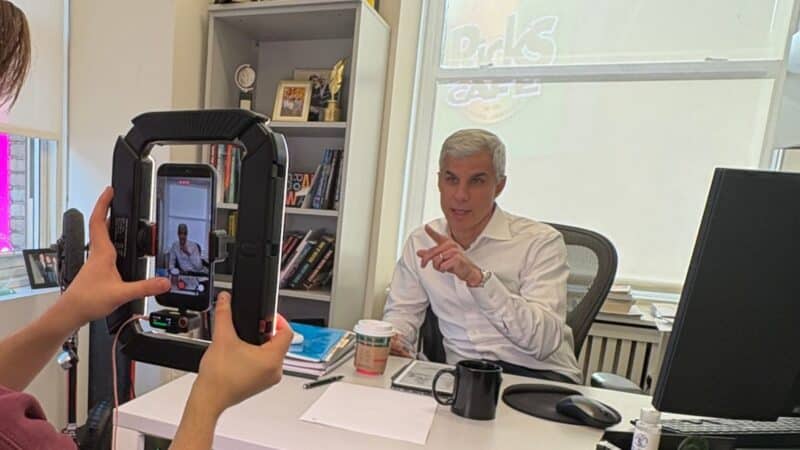
Ken created one of the first Broadway podcasts, recording over 250 episodes over 7 years. It features interviews with A-listers in the theater about how they “made it”, including 2 Pulitzer Prize Winners, 7 Academy Award Winners and 76 Tony Award winners. Notable guests include Pasek & Paul, Kenny Leon, Lynn Ahrens and more.