





Dramatic Marketing Episode 9: How Producing Deaf West’s Spring Awakening Changed Me (And What It Started for Broadway)
Before we went into rehearsals for Deaf West’s Spring Awakening, I had never had a real conversation with a deaf person.
I want you to sit with that for a second. I had been producing on Broadway for years. I had worked with hundreds of actors, directors, designers, stage managers. And I had never once had a meaningful conversation with a member of the deaf community.
That changed the moment we started this show. And I have never been the same since.
The Show Itself
Deaf West Theatre’s Spring Awakening opened at the Brooks Atkinson Theatre on September 27, 2015. It ran for 135 performances. It received three Tony nominations, including Best Revival of a Musical. It was performed simultaneously in English and American Sign Language . . . every scene, every song, every moment on that stage happening in two languages at once.
Michael Arden directed it. (My first time working with Michael . . . and I’ll tell you, not my last. There are directors who know how to create a world on stage. Michael creates a world and then invites you to live inside it.) The cast included Marlee Matlin, Camryn Manheim, Patrick Page, Russell Harvard, Krysta Rodriguez, Andy Mientus, Austin P. McKenzie, and Ali Stroker.
Ali was the first person in a wheelchair to appear on Broadway.
When I think about what that means (that in the entire history of Broadway, no one had done that before) it still gets me.
Why We Held the Symposium
About four months into the run, we held a symposium.
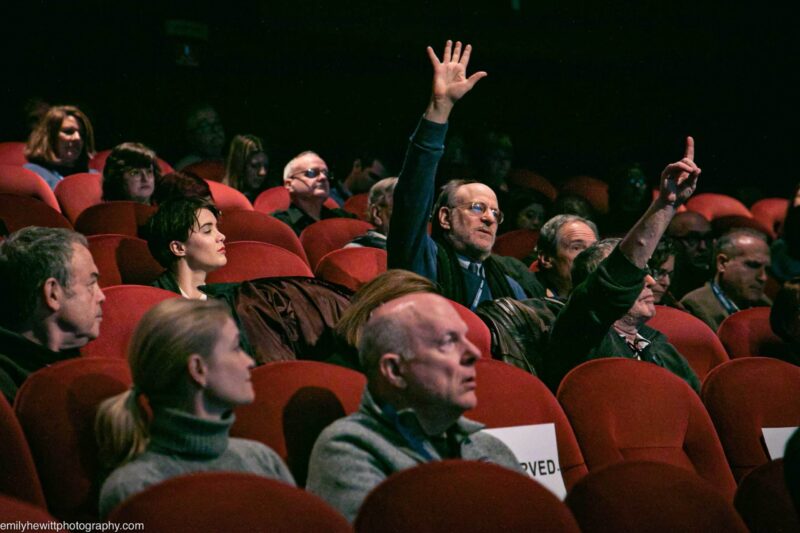
On January 15, 2016, presented in association with The Broadway League, we invited the entire industry to “How to Make Broadway More Accessible”. Every show. Every producer. Anyone who wanted to come and hear from experts about what it would actually take to make Broadway accessible — not just in the seats, but on the stages.
Timothy Shriver, Chairman of Special Olympics, volunteered his time and delivered the keynote.
Victor Calise, Commissioner of the Mayor’s Office for People with Disabilities, was on the panel. Lisa Goring from Autism Speaks. David J. Kurs, Artistic Director of Deaf West Theatre. These weren’t theoretical voices. These were people who had spent their careers working to make spaces like Broadway more welcoming to communities that had been excluded from them for too long.
And the industry showed up, folks. That’s the part I’ll never forget. They showed up.
What That Room Felt Like
There’s a version of Broadway I love but that also exhausts me — the version that’s competitive, territorial, protective of its own turf.
And then there’s the version I saw in that room on January 15th.
Everyone came. Everyone wanted to listen. Everyone wanted to change something.
That’s Broadway at its best. That’s what this industry can be when it decides to show up for something bigger than a hit show. No one was there to network or be seen. They were there because they believed, like I did, that we had not been doing enough — and that we could do more.
What Happened After
Three years after Spring Awakening closed, Ali Stroker won the Tony Award for Best Featured Actress in a Musical for Oklahoma!
She was the first actor in a wheelchair to win a Tony Award.
I was so proud of her that night.
There have been so many changes since that symposium in 2016. More accessibility accommodations. More representation on stages and in seats. More conversations that wouldn’t have happened without shows like Spring Awakening forcing them into the room.
And there is so much more still to do.
I will never stop believing that the theater has an obligation (not just an opportunity, an obligation) to reflect the full range of human experience. Not just the experiences of people who have always had easy access to it.
That symposium was one of the best things I’ve ever been part of as a producer. Not because of the reviews we got or the awards we were nominated for.
Because of what it started.
So here’s what I want to ask you: what do you think Broadway still needs to do to be truly accessible — for every audience member and every performer? Tell me in the comments.
Follow me on Instagram, LinkedIn, and YouTube for more business of Broadway insights and news

Podcasting
Ken created one of the first Broadway podcasts, recording over 250 episodes over 7 years. It features interviews with A-listers in the theater about how they “made it”, including 2 Pulitzer Prize Winners, 7 Academy Award Winners and 76 Tony Award winners. Notable guests include Pasek & Paul, Kenny Leon, Lynn Ahrens and more.